Crochet Abbreviations & How to Read a Crochet Pattern (US vs UK Terms)
CROCHET BASICS · PATTERNS
📖 How to Read a Crochet Pattern

A complete abbreviations list, US vs UK terms, and a line-by-line method
The first time I opened an English crochet pattern, it looked like a secret code: “Rnd 3: ch 3, 2 dc in same st, *dc in next st, 2 dc in next st; rep from * around, sl st to top of beg ch-3 (18 dc).” Today I can read that line as easily as a recipe — and by the end of this guide, so can you.
Below you will find a complete list of the crochet abbreviations you will actually meet, the very important difference between US and UK terms, and a step-by-step method for reading any written pattern.
Why Patterns Use Abbreviations
A full blanket pattern written in full sentences would be pages long and hard to follow. Abbreviations keep instructions short, so you can glance at a line while your hands keep working. Once you know about twenty abbreviations, you can read most patterns in the world.
The Most Important Crochet Abbreviations (US Terms)
| Abbreviation | Meaning |
|---|---|
| ch | chain |
| sl st | slip stitch |
| sc | single crochet |
| hdc | half double crochet |
| dc | double crochet |
| tr / tc | treble (triple) crochet |
| st(s) | stitch(es) |
| sp | space |
| ch-sp | chain space |
| rnd(s) | round(s) |
| RS / WS | right side / wrong side |
| inc | increase (2 sts in one st) |
| dec | decrease |
| sc2tog | single crochet 2 together (decrease) |
| dc2tog | double crochet 2 together |
| MR | magic ring |
| BLO / FLO | back loop only / front loop only |
| FPdc / BPdc | front post / back post double crochet |
| beg | beginning |
| rep | repeat |
| sk | skip |
| tog | together |
| yo | yarn over |
| PM | place marker |
US vs UK Crochet Terms — The Big Trap
This is the single most confusing thing in crochet: US and UK patterns use the same names for different stitches. A UK “double crochet” is a US “single crochet”. If you follow a UK pattern using US stitches, everything comes out much taller and larger than it should.
| US term | UK term |
|---|---|
| slip stitch (sl st) | slip stitch (ss) |
| single crochet (sc) | double crochet (dc) |
| half double crochet (hdc) | half treble (htr) |
| double crochet (dc) | treble (tr) |
| treble (tr) | double treble (dtr) |
| skip | miss |
| gauge | tension |
| yarn over (yo) | yarn over hook (yoh) |
🔎 How to tell which terms a pattern uses
- The pattern usually says “US terms” or “UK terms” near the top.
- If you see sc anywhere, it is US — UK patterns have no single crochet.
- UK patterns often use “tension” and “miss” instead of “gauge” and “skip”.
- All patterns on Cozy Stitch Haven use US terms.
Understanding Pattern Symbols and Punctuation
| Symbol | What it means | Example |
|---|---|---|
| * … ; | Repeat the part after the asterisk as instructed | *sc in next st, 2 sc in next st; rep from * around |
| ( ) or [ ] | Work everything inside into the same stitch or as a group | (2 dc, ch 2, 2 dc) in next ch-sp |
| [ ] x 3 | Repeat the bracketed group the stated number of times | [sc, ch 1] 3 times |
| (18) | Stitch count at the end of the row or round | …sl st to join (18 dc) |
| ch-2 sp | The space created by an earlier chain of 2 | sc in next ch-2 sp |
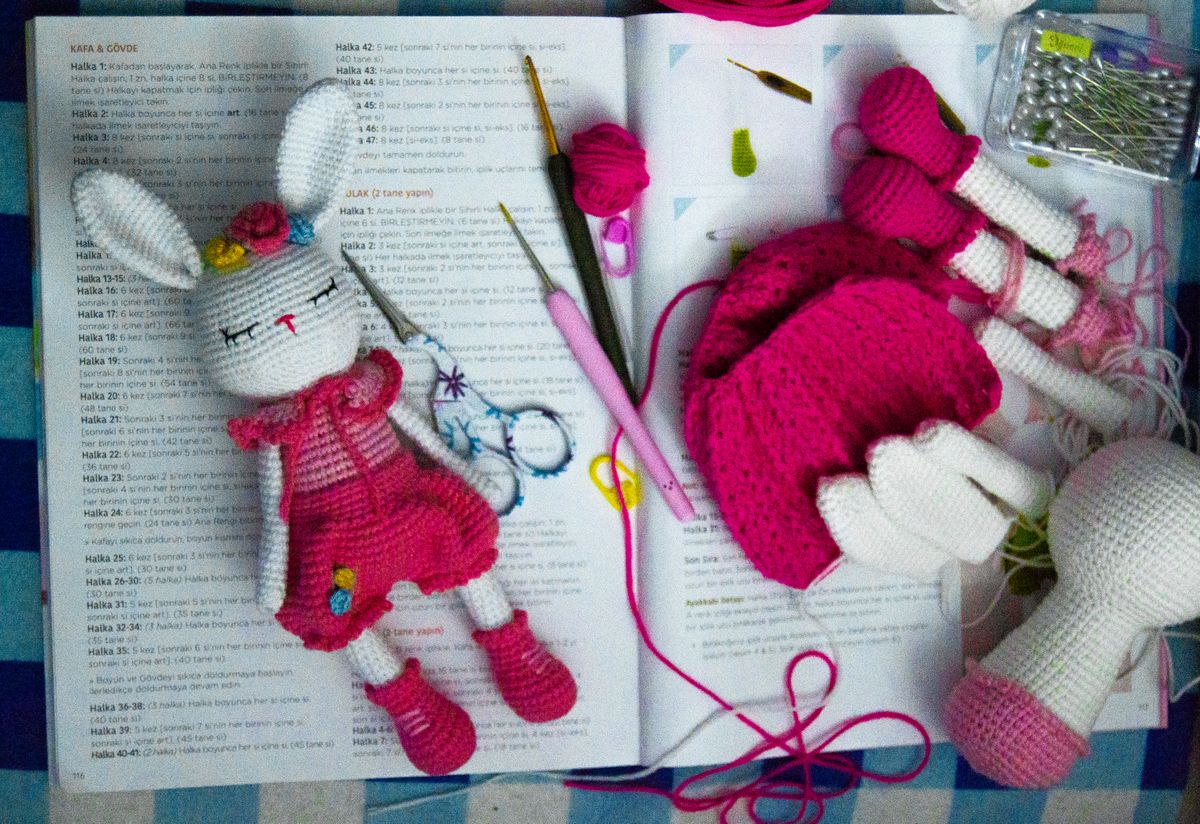
How to Read a Pattern Line, Step by Step
Let’s decode the line from the introduction:
Rnd 3: ch 3 (counts as dc), dc in same st, *dc in next st, 2 dc in next st; rep from * around, sl st to top of beg ch-3. (18 dc)
- Rnd 3 — you are working the third round (in a circle, not back-and-forth rows).
- ch 3 (counts as dc) — make 3 chains; they act as your first double crochet.
- dc in same st — make one more double crochet in the same stitch, so that stitch has 2 (an increase).
- *dc in next st, 2 dc in next st; — this is the repeating unit: one normal stitch, then one increase.
- rep from * around — keep repeating that unit until you get back to the start.
- sl st to top of beg ch-3 — join the round with a slip stitch into the 3rd chain of the starting chain.
- (18 dc) — count! You should have 18 stitches. If not, find the mistake now.
The Anatomy of a Good Pattern
Before you start, read the whole pattern once. Most patterns are organised like this:
- Skill level — beginner, easy, intermediate, experienced.
- Materials — yarn (weight, fibre, amount), hook size, notions such as stitch markers or keyrings.
- Gauge — how many stitches and rows fit in 10 cm / 4 in.
- Finished size.
- Abbreviations and special stitches.
- Notes — e.g. “ch 3 counts as a stitch”, “do not join rounds”.
- Instructions — row by row or round by round.
- Finishing — weaving in ends, assembly, blocking.
My 6 Tips for Reading Patterns Without Mistakes
- Highlight the line you are working on, or use a sticky note under it.
- Tick each row as you finish it.
- Use a stitch marker in the first stitch of every round.
- Always check the stitch count in brackets.
- Read the notes section — answers to most “this doesn’t work” moments are there.
- When a step is confusing, read it slowly out loud. It really helps!
Reading Crochet Charts
Many patterns also include a chart: a drawing in which each stitch is a symbol. A chain is a small oval, a slip stitch a dot, single crochet a cross or “x”, and double crochet a “T” with a small line through the stem. Charts are read in the direction you crochet — rounds start from the centre, and rows alternate right-to-left and left-to-right. Charts are universal, so they are a lifesaver for patterns in languages you don’t speak.
🧶 Helpful tools for reading patterns
This box contains affiliate links. As an Amazon Associate I earn from qualifying purchases, at no extra cost to you. Learn more.
- Crochet stitch dictionary – every stitch and symbol explained in one book
- Row counter – keep your place in long patterns
- Locking stitch markers – mark repeats and pattern sections
- Highlighter tape – track the line you are working on
Frequently Asked Questions
Does the turning chain count as a stitch?
It depends on the pattern. Usually ch 1 does not count, while ch 2 or ch 3 often does. The pattern notes will tell you.
What does “work even” mean?
Work one stitch in each stitch, with no increases or decreases.
What is the difference between “in next st” and “in next sp”?
“St” means you insert the hook into the top of a stitch; “sp” means you insert it into the gap or under a chain, which gives a more open look.
🧶 You May Also Like
Written by Cozy Stitch Haven


Comments
Post a Comment